Chattanooga grew from Ross's Landing and was incorporated in 1839. Here are its museums and all 98 National Register listings with a Chattanooga address.
Last checked Oct. 17, 2026. History comes from the Tennessee Historical Society’s Tennessee Encyclopedia entry on Chattanooga; the incorporation date from the University of Tennessee Municipal Technical Advisory Service city profile; National Register listings from the National Park Service’s list of listed properties (file dated May 22, 2026); and visiting details from each site’s own website, linked below.
Chattanooga began as Ross’s Landing, a trading post settled in the early 1830s near the foot of today’s Broad Street on the Tennessee River. Its residents incorporated the town of Chattanooga on Nov. 1, 1839, under a private act of the Tennessee General Assembly; the city has run under a home rule charter since 1972. Today 98 places with a Chattanooga address are on the National Register of Historic Places. For directions to city-run sites such as Coolidge Park and the Walnut Street Bridge, call the city’s 311 line at 423-643-6311.
Plan a visit
- Chickamauga and Chattanooga National Military Park: nps.gov/chch
- Chattanooga National Cemetery: 1200 Bailey Ave., cem.va.gov
- Bessie Smith Cultural Center: bessiesmithcc.org, 10 a.m. to 5 p.m. Tuesday to Friday
- Tennessee Valley Railroad Museum: Grand Junction Depot off Cromwell Road, tvrail.com
How Chattanooga began
People lived at this bend in the Tennessee River long before the city. The Tennessee Encyclopedia says archaeological digs show Native Americans settled the site more than 8,000 years ago, and that around A.D. 1300 it was a center of Mississippian culture. The Cherokees later called the spot Chado-na-ugsa, “rock that comes to a point,” a reference to Lookout Mountain.
- Early 1830s: permanent white settlers established Ross’s Landing.
- 1839: the settlement of 53 families was incorporated as the town of Chattanooga (Nov. 1, 1839, in the state’s records).
- 1850: the Western and Atlantic, the city’s first railroad, arrived; by 1860 Chattanooga was a vital link in the region’s rail system.
- 1863: the battles of Chickamauga and Chattanooga caused more than 47,000 casualties on both sides. Union forces secured the city that November and turned it into a supply and rail center.
- 1880s: an industrial boom, led in part by Chattanooga Times publisher Adolph S. Ochs, then a collapse in property values and the Panic of 1893.
- 1899: three local men, Ben F. Thomas, Joseph B. Whitehead and John T. Lupton, secured the exclusive rights to bottle Coca-Cola.
- 1933: the Tennessee Valley Authority arrived; projects such as Chickamauga Dam put residents to work.
- Late 1960s: Chattanooga was among the nation’s most polluted cities; strict pollution laws followed.
Historic districts
Ten National Register historic districts lie in the city:
- Fort Wood (listed 1979), Ferger Place (1980) and St. Elmo (1982), three of the four districts where the city’s Historic Zoning Commission also reviews exterior changes
- Martin Luther King Boulevard (1984) and Market Street Warehouse (1984)
- Glenwood (1989), Market and Main Streets (1992) and Missionary Ridge (1996)
- Stone Fort Land Company (1999) and Downtown Chattanooga (2020)
Landmarks to see
- Walnut Street Bridge: built in 1890, 2,376 feet long, now a pedestrian bridge (National Register 1990).
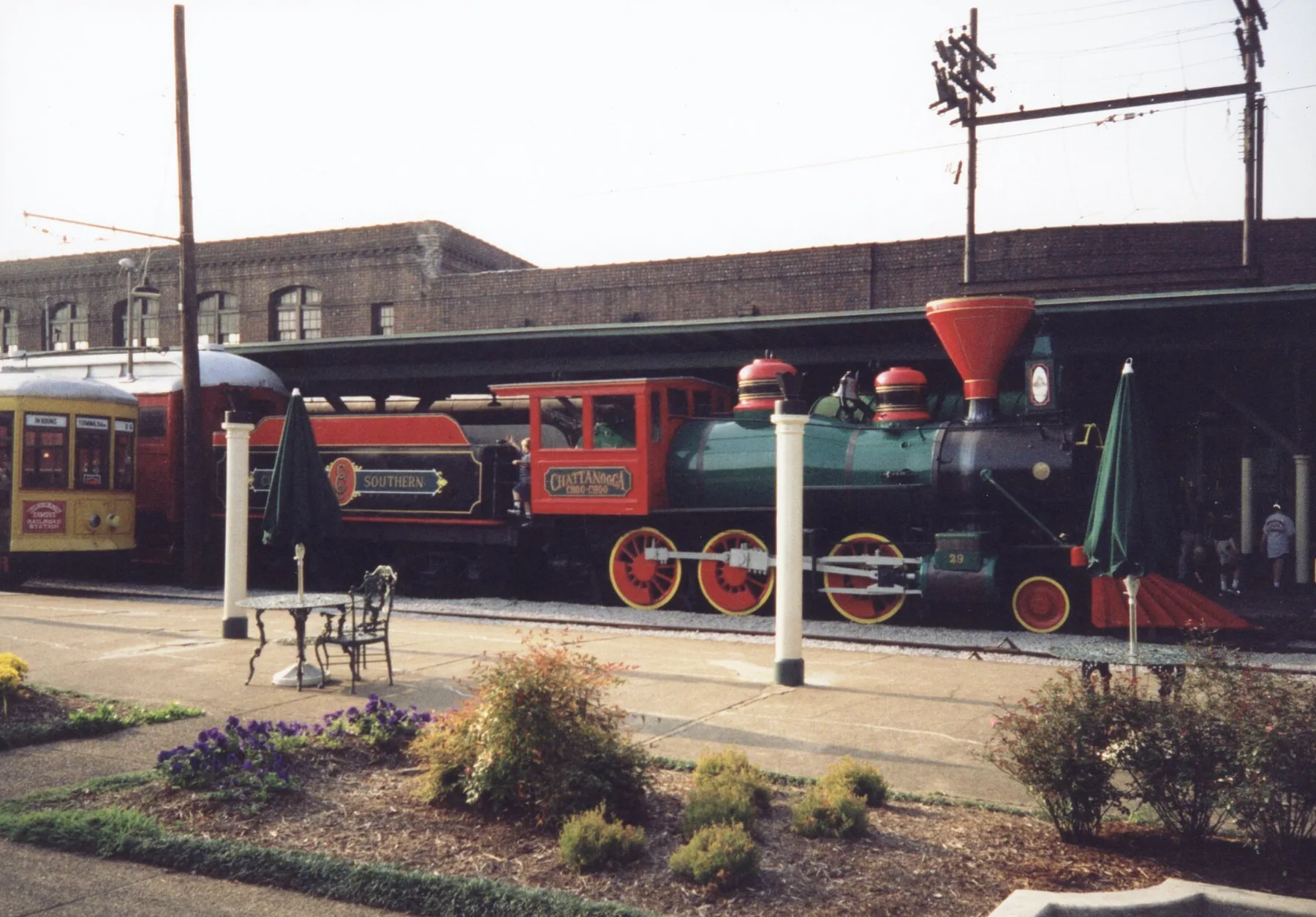
- Terminal Station, 1434 Market St.: now the Chattanooga Choo Choo (National Register 1973).
- Ross’s Landing, on Riverfront Parkway west of Market Street, where the city began (1974).
- Lookout Mountain Incline Railway (1973) and the Market Street Bridge (2010).
- Hamilton County Courthouse, W. Sixth Street and Georgia Avenue (1978).
- Bud Ellis Carousel in Coolidge Park, a restored 1894 Dentzel carousel, 11 a.m. to 7 p.m. daily.
Museums and cemeteries open to visitors
- Chickamauga and Chattanooga National Military Park: the National Park Service preserves the 1863 battlefields around the city; check the park’s hours page before you go.
- Bessie Smith Cultural Center: open 10 a.m. to 5 p.m. Tuesday to Friday, closed Saturday to Monday. It is closed Wednesday, Oct. 21, 2026, for upgrades.
- Tennessee Valley Railroad Museum: train rides and exhibits from Grand Junction Depot; take I-75 to Exit 4 (State Route 153), then the Jersey Pike exit to Cromwell Road. CARTA route 19 stops nearby on weekdays. Its rolling stock was listed on the National Register in 1980.
- Chattanooga National Cemetery, 1200 Bailey Ave.: a national cemetery run by the U.S. Department of Veterans Affairs (National Register 1996).
- Brainerd Mission Cemetery, 5700 Eastgate Loop: marked by the National Park Service as a site on the Trail of Tears National Historic Trail (National Register 1979).
Every National Register listing with a Chattanooga address
From the National Park Service’s list of listed properties, May 22, 2026, sorted by the year each was listed. Archaeological sites have restricted addresses to protect them. Entries marked “additional documentation” had more paperwork filed after the original listing.
| Listed | Property | Address |
|---|---|---|
| 1971 | Brown’s Ferry Tavern | Brown’s Ferry Rd. |
| 1973 | Terminal Station | 1434 Market St. |
| 1973 | Old Library Building | 200 E. 8th St. |
| 1973 | Brabson House (additional documentation filed later) | 407 E. 5th St. |
| 1973 | Tivoli Theater (additional documentation filed later) | 709 Broad St. |
| 1973 | Williams Island | Address restricted |
| 1973 | Old Post Office (additional documentation filed later) | 31 E. 11th Street |
| 1973 | Lookout Mountain Incline Railway | Off U.S. 11 |
| 1974 | Ross’s Landing | Riverfront Pkwy. west of Market St. |
| 1976 | Civil War Fortification | Bonny Oaks Dr. |
| 1976 | Read House (additional documentation filed later) | 107 West M.L.K. Boulevard |
| 1978 | Chattanooga, Harrison, Georgetown & Charleston Railroad Tunnel | Below N. Crest Rd. |
| 1978 | St. Paul’s Episcopal Church | 7th and Pine Sts. |
| 1978 | Ochs Building | Georgia Ave. |
| 1978 | Hamilton County Courthouse | W. 6th St. and Georgia Ave. |
| 1978 | Hutcheson House | 360 S. Crest Rd. |
| 1979 | Shiloh Baptist Church | 506 E. 8th St. |
| 1979 | Fountain Square | 600-622 Georgia Ave. and 317 Oak St. |
| 1979 | Mikado Locomotive No. 4501 | 2202 N. Chamberlain Ave. |
| 1979 | Fort Wood Historic District | Roughly bounded by Palmetto, McCallie, Central and 5th Sts. |
| 1979 | Chattanooga Car Barns | 301 Market St. |
| 1979 | Wiley United Methodist Church | 504 Lookout St. |
| 1979 | Brainerd Mission Cemetery | 5700 Eastgate Loop |
| 1979 | Gaskill House | 427 E. 5th St. |
| 1979 | Saints Peter and Paul Catholic Church and Buildings | 214 E. 8th St. |
| 1980 | Chattanooga Electric Railway | 211-241 Market St. |
| 1980 | First Baptist Church Education Building | 317 Oak St. |
| 1980 | Highland Park Methodist Episcopal church | Bailey Ave. |
| 1980 | James Building | 735 Broad St. |
| 1980 | Municipal Building | E. 11th St. |
| 1980 | Second Presbyterian Church | 700 Pine St. |
| 1980 | U.S. Post Office | Georgia Ave. |
| 1980 | Willard, Frances, House | 615 Lindsay St. |
| 1980 | Ferger Place Historic District | Evening Side Dr. and Morning Side Dr. |
| 1980 | Market Square-Patten Parkway | Roughly bounded by E. 8th, and E. 9th Sts., Georgia and Lindsay Aves. |
| 1980 | East Tennessee Iron Manufacturing Company Blast Furnace | Address restricted |
| 1980 | Kelley House | 1903 McCallie Ave. |
| 1980 | Cummings, Judge Will, House | W. of Chattanooga at 4025 Cummings Rd. |
| 1980 | Tennessee Valley Railroad Museum Rolling Stock | 2022 N. Chamberlain Ave. |
| 1980 | Bonny Oaks | 5114 Bonny Oaks Dr. |
| 1980 | Brainerd Junior High | 4201 Cherryton Dr. |
| 1980 | Chattanooga Bank Building | 8th St. |
| 1980 | Medical Arts Building | McCallie Ave. |
| 1980 | Northside United Presbyterian | 923 Mississippi Ave. |
| 1980 | Soldiers and Sailors Memorial Auditorium | McCallie Ave. |
| 1980 | Faxon-Thomas Mansion | 10 Bluff View Ave. |
| 1982 | Isbester, Caleb, House | 551 Oak St. |
| 1982 | St. Elmo Historic District | Alabama, St. Elmo, and Tennessee Aves. |
| 1982 | Audubon Acres Site (40 HA 84) | Address restricted |
| 1983 | Southern Railway Freight Depot | 1140 Newby St. |
| 1983 | Crane Building | 1317 Chestnut St. |
| 1984 | King, M. L., Boulevard Historic District | Roughly M. L. King Blvd. between Browns and University Sts. |
| 1984 | Market Street Warehouse Historic District | 1118-1148 Market St. |
| 1984 | Hampton Place Archeological Site (40HA146) | Address restricted |
| 1984 | Mallards Dozen Archeological Site (40HA147) | Address restricted |
| 1984 | Stringer Ridge Historic District | Address restricted |
| 1984 | Vulcan Archeological Site (40HA140) | Address restricted |
| 1984 | Woodland Mound Archeological District | Address restricted |
| 1984 | Schwartz, Robert, and Company Building | 736-738 Cherry St. |
| 1985 | Maclellan Building | 721 Broad St. |
| 1985 | Lookout Mountain Caverns and Cavern Castle | Scenic Hwy. |
| 1986 | Trigg-Smartt Building (additional documentation filed later) | 701-707 Broad St. |
| 1986 | Moccasin Bend Archeological District; National Historic Landmark 1986 | Address restricted |
| 1986 | Wyatt Hall | 865 E. Third St. |
| 1987 | Miller Brothers Department Store | 629 Market St. |
| 1989 | Glenwood Historic District | Roughly bounded by Parkwood Dr., Glenwood Dr., Oak St., and Derby St. |
| 1990 | Walnut Street Bridge | Walnut St., over the Tennessee River |
| 1990 | Cravens-Coleman House | 1 Cravens Ter. |
| 1992 | McConnell, Chancellor T. M., House | 517 E. Fifth St. |
| 1992 | Turnbull Cone and Machine Company | 1400 Fort and W. Fourteenth Sts. |
| 1992 | Market and Main Streets Historic District | Roughly bounded by Cowart, King, Market and Main Sts. |
| 1993 | Shavin, Seamour and Gerte, House | 334 N. Crest Rd. |
| 1993 | Model Electric Home | 1516 Sunset Rd. |
| 1995 | Central Block Building | 630-638 Market St. |
| 1996 | Missionary Ridge Historic District | N. and S. Crest Rd. from Delong Reservation to 700 S. Crest Rd. |
| 1996 | Chattanooga National Cemetery | 1200 Bailey Ave. |
| 1998 | Louise Terrace Apartments | 314 and 316 Walnut St. |
| 1999 | Signal Knitting Mills | 205 Manufacturers Rd. |
| 1999 | Stone Fort Land Company Historic District | 10th, Newby, E. 11th and Market Sts. |
| 1999 | Chattanooga Plow Power House | 1533-1535 Chestnut St. |
| 2009 | First Presbyterian Church | 554 McCallie Ave. |
| 2009 | Engel Stadium | O’Neal St. and E. 3rd St. |
| 2009 | Jones, Clarence T., Observatory | 10 N. Tuxedo Ave. |
| 2010 | First Congregational Church | 901 Lindsay St |
| 2010 | Ridgedale Methodist Episcopal Church | 1518 Dodds Ave |
| 2010 | Market Street Bridge | Market St over the Tennessee River |
| 2011 | Oak Grove Elementary School (additional documentation filed later) | 1912 South Willow St. |
| 2012 | Highland Park Methodist Episcopal Church, South | 1918 Union Ave. |
| 2014 | Standard-Coosa-Thatcher Mills | 1800 Watkins St. |
| 2017 | Chickamauga Hydroelectric Project | 5400 Lake Resort Dr. |
| 2020 | Dixie Mercerizing Company | 951 South Watkins St. |
| 2020 | Downtown Chattanooga Historic District | Roughly bounded by Martin Luther King Jr. Blvd., Georgia Ave., East 5th St., Walnut St., East 6th St., and Chestnut St. |
| 2021 | Christ Church Episcopal | 663 Douglas St. |
| 2021 | Price-Evans Foundry | 901 South Holtzclaw Ave. |
| 2021 | Beck Knob Cemetery | 875 Dartmouth St. |
| 2022 | Ridgedale Lodge | 2602 East Main St. |
| 2025 | Pleasant Garden Cemetery | 306 Rowe Road |
| 2026 | St. Marks United Methodist Church | 701 Mississippi Avenue |
What this means for you
- Owners in St. Elmo, Fort Wood and Ferger Place need city historic zoning approval for exterior work; see our permits and zoning guide.
- The National Park Service’s listed properties spreadsheet links many listings to their nomination files in the National Archives catalog.
Related guides: parks and trails, getting around Chattanooga and Chattanooga population.
Frequently asked questions
When was Chattanooga founded?
Settlers established Ross’s Landing, a trading post on the Tennessee River near the foot of today’s Broad Street, in the early 1830s. The settlement was incorporated as the town of Chattanooga on Nov. 1, 1839.
What does the name Chattanooga mean?
The Tennessee Encyclopedia says the Cherokee called the spot Chado-na-ugsa, meaning “rock that comes to a point,” a reference to Lookout Mountain.
How many National Register of Historic Places listings are in Chattanooga?
98 entries in the National Park Service’s list carry a Chattanooga address, from Brown’s Ferry Tavern (listed 1971) to St. Marks United Methodist Church (2026). Moccasin Bend Archeological District is also a National Historic Landmark.
When was the Walnut Street Bridge built?
In 1890. The 2,376-foot bridge, now a pedestrian bridge, was listed on the National Register in 1990.
Have your say